Industry Knowledge
Different track gauge around the world !
In the early days of rail travel, there was no universal standard for track gauges. Many engineers, private companies and countries would simply build tracks to their designs. Often train tracks were built to link neighbouring towns together or designed for private use. Since these tracks didn’t need to connect, there was little need to standardize. Some countries chose not to use the standard gauge for political reasons such as to avoid being invaded by other countries.
It is also worth remembering that replacing or regauging track is a pretty expensive affair. For this reason, it is not unusual to find a mixture of gauges in use in countries where converting gauges is not necessary.
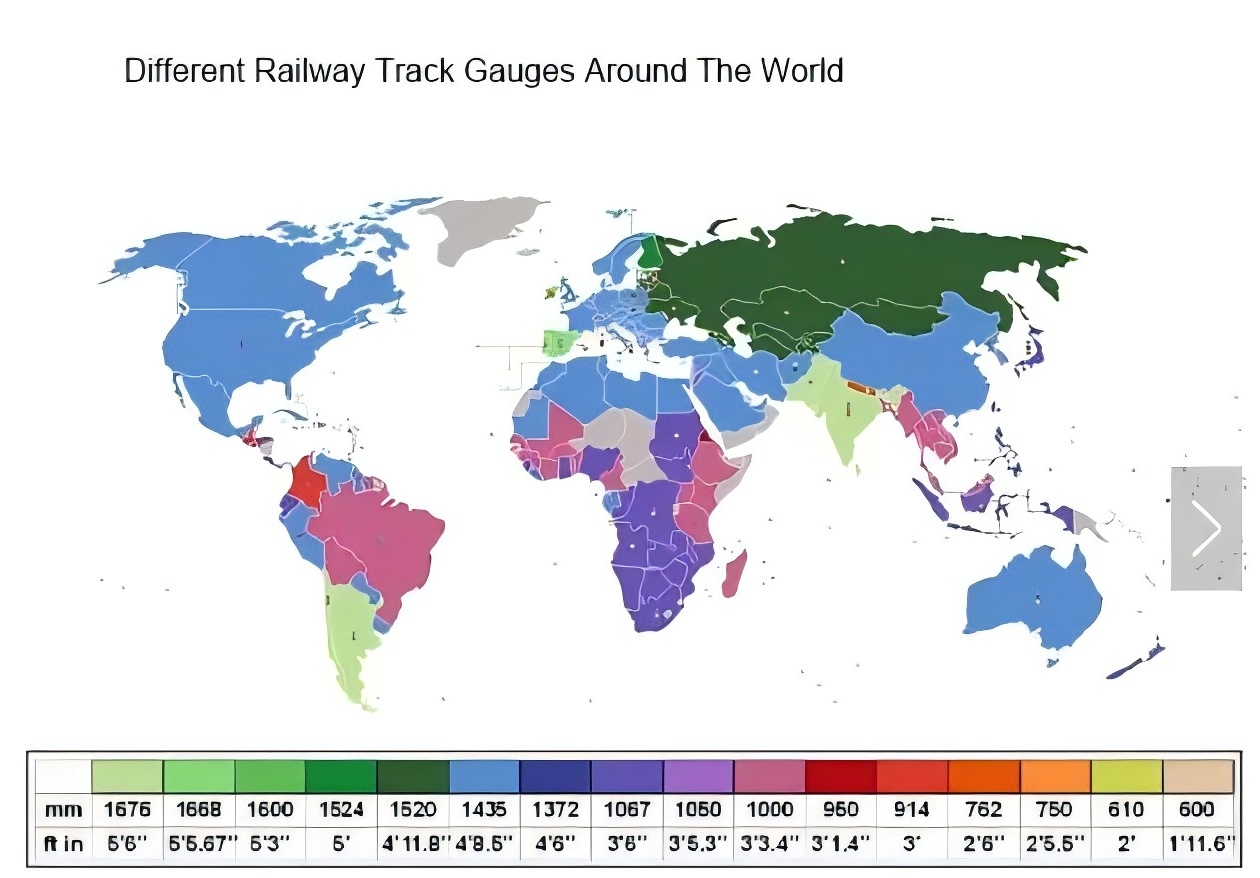
| Railway Track Gauge | Countries |
| 2134mm ( 7ft ) | UK |
| 1829mm | Moscow-St. Petersburg Line, U.S. Erie Line |
| 1674mm (5ft 5in) | Spain |
| 1665mm (5ft 5in) | Portugal |
| 1600mm | Ireland, Northern Ireland (UK), Australia (Victoria and South Australia), Brazil |
| 1524mm (5 feet) 1520mm | Russia, Kazakhstan, Kyrgyzstan, Uzbekistan, Turkmenistan, Georgia, Azerbaijan, Armeria, Estonia, Latvia, Lithuania, Russia, Belarus, Ukraine, Moldova, Mongolia, Finland (Grand Duchy of Russia in the 19th century), Peak Cable car (Hong Kong, China) |
| 1435mm (4ft 8½in) | China, North Korea, South Korea, Japan (Tokaido, Sanyo and other Shinkansen), Iran, Iraq, Syria, Lebanon, Israel, Turkey, Egypt, Tunisia, Mauritania, Gabon, Denmark, Norway, Sweden, Poland, Czech Republic, Slovakia, Hungary, Germany, Austria, Liechtenstein, Switzerland, Netherlands, Belgium, Luxembourg, United Kingdom, France, Monaco, Italy, Vatican, Yugoslavia, Slovenia, Croatia, Bosnia and Herzegovina, Macedonia, Romania, Bulgaria, Albania, Greece, United States, Canada, Mexico, Cuba, Dominica, Colombia, Venezuela, Guyana, Peru, Argentina, Paraguay, Uruguay, Australia, Taiwan High-Speed Rail, Taipei MRT and Kaohsiung MRT-Taiwan Taoyuan International Airport MRT (China Taiwan), East Rail Line-West Rail Line-Light Rail and Maanshan Line (Hong Kong, China), Madrid-Serbia High-Speed Railway (Spain) |
| 1432mm | London Underground (UK), Tsuen Wan Line-Island Line-Tung Chung Line-Machine Line Express-Tseung Kwan O Line (Hong Kong, China) |
| 1372mm | Keiking Electric Railway – Tokyu Shinjuku Line – Hakodate Shibuya Line – Dotoku Line (Japan) |
| 1067mm | Japan (80%), Australia (Queensland), New Zealand, Taiwan Province (China), India, Pakistan, Ghana, Congo, Tanzania, Zambia, Indonesia, South Africa, Angola, Botswana, Jordan, Algeria, Morocco, Sierra Leone, Liberia, Nigeria, Angola, Zimbabwe, Malawi, Mozambique, Swaziland, Namibia, Sudan, Ghana, Lesotho, Honduras, Costa Rica, Dominica, Ecuador, the Philippines, Hainan Province (China), South Sakhalin ( Sakhalin) (Russia) |
| 1090mm | Switzerland |
| 1050mm | Palestine, Angola |
| 1000mm | China (Kunming to Hekou), Vietnam, Cambodia, Laos, Thailand, Malaysia, Myanmar, India, Bangladesh, Pakistan, Mali, Guinea, Senegal, Burkina Faso, Côte d’Ivoire, Togo, Benin, Cameroon, Ethiopia, Tunisia, Djibouti, Kenya, Uganda, Tanzania, Madagascar, Switzerland, Spain, Puerto Rico, Brazil |
| 914mm | Panama, Colombia, El Salvador, Guatemala, Peru |
| 800mm | Switzerland |
| 762mm | Sugar Railway, Alishan Forest Railway, Eastern Taitung Line (Taiwan, China) |
| 760mm | India, Nepal, Indonesia |
| 610mm | India |
The best railway track Gauge
Since the emergence of railways in the 19th century, there has been debate about which gauge is the best. From a modern point of view, there is no obvious advantage in performance of wide or narrow gauge.
1. The heaviest truck in the world can run on standard gauge rails in the United States and Australia. The broad gauge does not necessarily carry more weight.
2. High-speed railways use standard gauges, and broad gauges are not necessarily faster.
3. Trains on narrow gauge (1067mm) railways in Queensland, Australia and South Africa are still very heavy. Narrow gauges do not necessarily carry less load.
4. The price difference between the standard-gauge light railway and the narrow-gauge railway is not much different.
5. Narrow gauge railways can also be built to reach the same load capacity as standard gauge railway tracks.
Only when narrow-gauge railways less than 3 feet will cost slightly less than standard gauges. However, the carrying capacity of this type of gauge is limited, and it is usually only used on mountain railways with limited carrying capacity.
CATEGORIES
LATEST NEWS
CONTACT US
Contact: Jodie Yuan
WhatsApp & WeChat :
+86 13871624533
Email: export@linkagetrack.com